Already a member? Sign In
Depiction Beyond The Gods: When Greek Astronomers Thought Beyond Mythologies
Depiction Beyond The Gods: When Greek Astronomers Thought Beyond Mythologies
Already a Customer?
Couldn't load pickup availability
Already a member? Sign In
Best Value
Six months of unlimited access on every eBook.
What if the universe was not ruled by the moods of gods but by patterns waiting to be discovered?
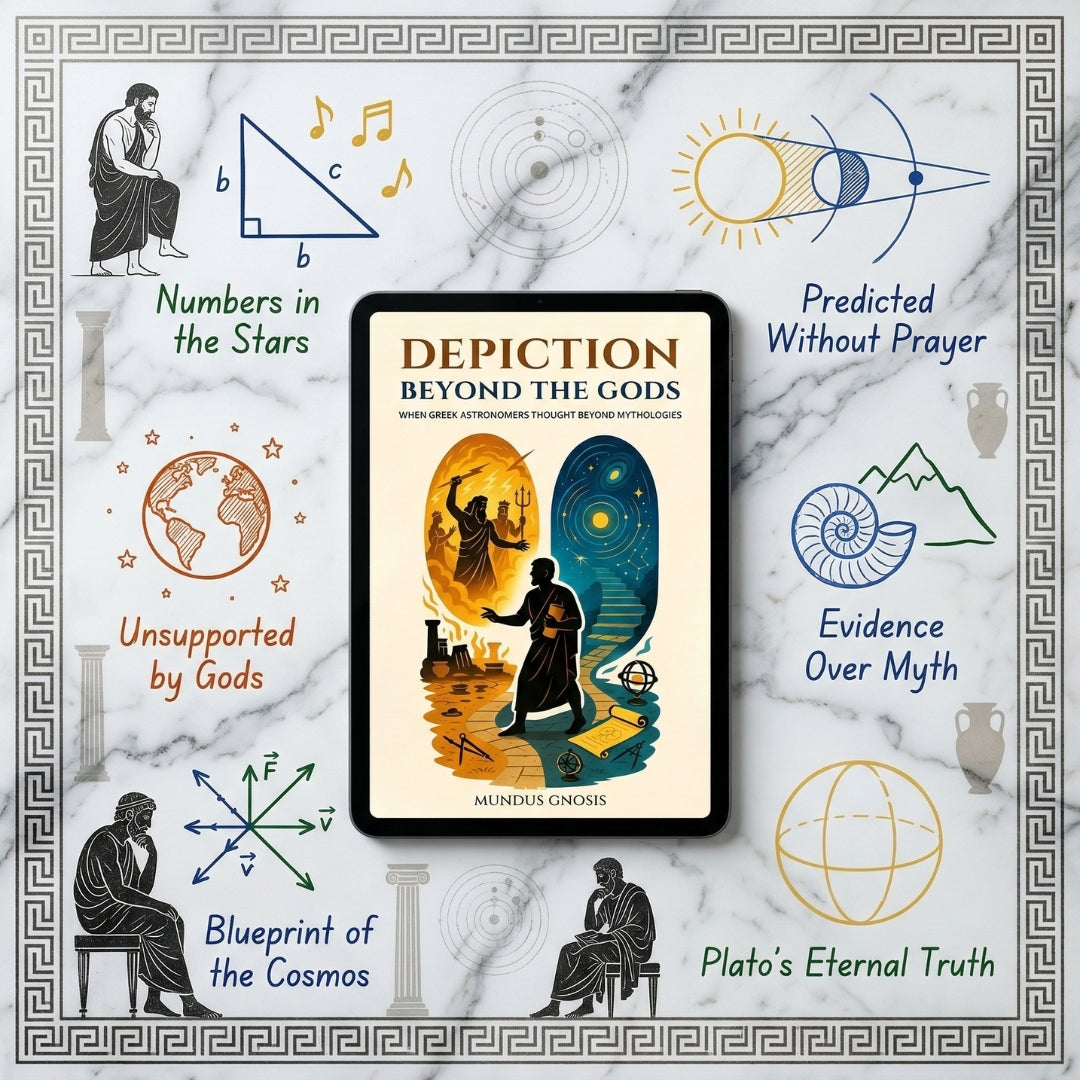
Before Apollo aimed his golden bow and before Zeus sent thunder from Olympus, there were thinkers who dared to strip the sky of superstition. They were not mythmakers, they were mindbreakers and pioneers who believed the heavens were not divine stage plays but lawful and measurable realities. Depiction Beyond the Gods takes you back to that quiet revolution when reason first rose above ritual and observation began to overpower belief.
This codex is not about mythology. It is about the earliest rebellion against it.
Step into the age where Thales of Miletus looked to the sky and predicted an eclipse not with prayer but with reason. Travel through the minds of Anaximander, Anaximenes, Heraclitus, Pythagoras, and other intellectual titans who believed the universe was not just to be feared but to be understood. These were the first men who believed that the cosmos had order and that humans could uncover it.
Inside, you will experience:
How the First Philosophers Separated Cosmos from Chaos:
Learn how Thales explained natural phenomena using logic, predicted eclipses, and inspired a shift from mythic narratives to rational thinking. He asked not what the gods wanted but how the world worked.
Anaximander’s Bold Leap into the Unknown:
He proposed that Earth floated in space, unsupported by divine beasts or columns. His ideas were radical and his drawings were among the first maps of the known world. He wasn’t just guessing because he was hypothesizing.
Anaximenes and the Breath of the Universe:
To him, air was the primal substance of everything. From rarefaction to condensation, his theory brought unity to the natural world and redefined how people thought about substance and transformation.
Pythagoras and the Harmony of the Heavens:
Pythagoras saw numbers in the stars. He linked math, music, and astronomy into a single system of elegant design. His ideas influenced Plato and later led to the notion of the music of the spheres.
Xenophanes and the Courage to Question the Gods:
He observed fossils and ocean shells on mountains and used them to challenge mythic accounts of creation. He criticized the anthropomorphism of deities and demanded that truth be tested rather than told.
Plato’s Geometry of the Universe:
He believed the universe was designed with perfect forms and that behind the material world lay eternal truths. His celestial spheres and mathematical aesthetics shaped cosmology for millennia.
Aristotle’s Blueprint for Physical Law:
Aristotle didn’t just theorize because he systemized. He built frameworks for motion, elements, causes, and celestial mechanics. His models influenced every medieval and early modern scientist who came after.
This codex is more than a collection of names because it is the story of thought itself being born.
It reveals how a civilization rooted in poetry and prophecy produced minds that reached beyond Olympus and into the stars. These thinkers didn’t destroy myths because they outgrew them. They transformed awe into inquiry, mystery into method, and fate into understanding.
If you have ever wondered how humans first broke free from myth and began to grasp the laws of the universe, this is your invitation to return to the moment when science was born.
Share